Rent Please! Landlord Sim
- 4.4
- Rating
- 10.00M
- Installs
- Free
- Price

 Analysis by App-foxy
I approached Rent Please! Landlord Sim as a decision rather than a quick download: is this the kind of simulation game that rewards a few relaxed check-ins, or does it demand the attention of a more traditional management game? After spending time with its landlord theme, I found a light, accessible experience built around gradual progress and small operational choices. It is free to play, aimed at Everyone, and developed by ShimmerGames, so it is easy to try without making a financial commitment at the start.
The basic appeal is simple. You take responsibility for rental properties, improve what you manage, and watch the business grow while the game continues to move at an idle-friendly pace. That makes it a natural fit for players who enjoy seeing numbers and spaces develop over time, but it also creates the main question you should ask before installing: do you want a relaxed property simulator, or a detailed management game where every decision has serious consequences?
What to consider before choosing this landlord simulator
My first decision criterion is the amount of attention a game expects. This is not the sort of experience I would choose when I want a demanding strategy session with complicated spreadsheets, long planning chains, or constant pressure. Its landlord concept works better as a gentle routine: open the game, collect progress, make a few improvements, and leave it until the next convenient moment.
You May Also Like

 Blood Strike: 2.5 Anniversary
Blood Strike’s Loadouts Turn Every Drop Into a Tactical Gamble
A close look at Blood Strike’s custom loadouts: how fast access to signature weapons reshapes its battle royale rhythm, rewards preparation, and narrows the gap between fights.

 Pandora - Music & Podcasts
Pandora’s Music Is Easy to Start, but Harder to Recover
Pandora’s strength is its low-effort path from a seed to a station. Its weak spot is how much confidence it asks you to place in connection, setup, and quiet recovery.

 8 Ball Pool
 Is Built on Rivalries, Rematches, and Routine
A close look at the rivalries, rematches, shared routines, and unanswered safety questions that turn a quick pool match into a persistent mobile community.

 Samsung Music
’s Quiet Strength Is Playing What You Already Own
Its reach comes less from spectacle than from dependable access to a personal library. That simplicity is both the app’s strongest retention engine and its ceiling.

 AccuWeather: Weather Radar
AccuWeather Review: A Quick, Clear Forecast for Everyday Decisions
For everyday plans, the best forecast is the one you can understand quickly. AccuWeather makes rain timing, radar, and local conditions easy to act on, with a few trade-offs.

 Hill Climb Racing
Why Hill Climb Racing Still Turns Crashes Into One More Run
A tiny car, a bumpy hill and one more upgrade: Hill Climb Racing keeps resurfacing because its simple chaos makes every near-miss feel personal.
More From Our News Desk



That rhythm is especially useful on a busy day. I can imagine checking it during a short break, upgrading a property, and returning later when there is enough progress to justify another round of decisions. It does not need to become the center of an evening. In fact, I think it is more enjoyable when treated as a small, repeatable habit instead of a game that must be completed in one sitting.
The second criterion is how much control you want. Simulation fans often use the word “management” to mean very different things. Some want detailed financial planning, while others mainly want a satisfying loop of earning, upgrading, and unlocking. Rent Please! Landlord Sim belongs closer to the second group. It gives the fantasy of running rental properties without asking me to behave like a professional property accountant.
That accessibility is a strength for newcomers. Someone who normally avoids simulation games can understand the landlord premise quickly, follow the visible goals, and learn through short sessions. The trade-off is that experienced tycoon players may find the decision space less demanding than they expect. If your enjoyment comes from carefully balancing many competing systems at once, this may feel more like a casual interpretation of property management than a full business simulation.
The third criterion is patience. Idle games are built around delayed rewards, and this one is no exception in spirit. Progress feels best when I accept that not every improvement has to happen immediately. The temptation is to keep checking for the next upgrade, but the more sensible approach is to make a clear improvement, close the game, and return later. That small change in attitude makes the waiting feel like part of the design rather than an inconvenience.
It is also worth considering the payment model before you begin. The game is free to download, with optional in-app purchases ranging from $0.99 to $99.99 per item. I would recommend deciding in advance whether you are comfortable spending anything. The safest way to enjoy this type of game is to treat purchases as optional convenience rather than as part of the basic admission price. Players who dislike timers, gradual progression, or any temptation to accelerate progress should be particularly cautious.
The first sessions and the landlord fantasy
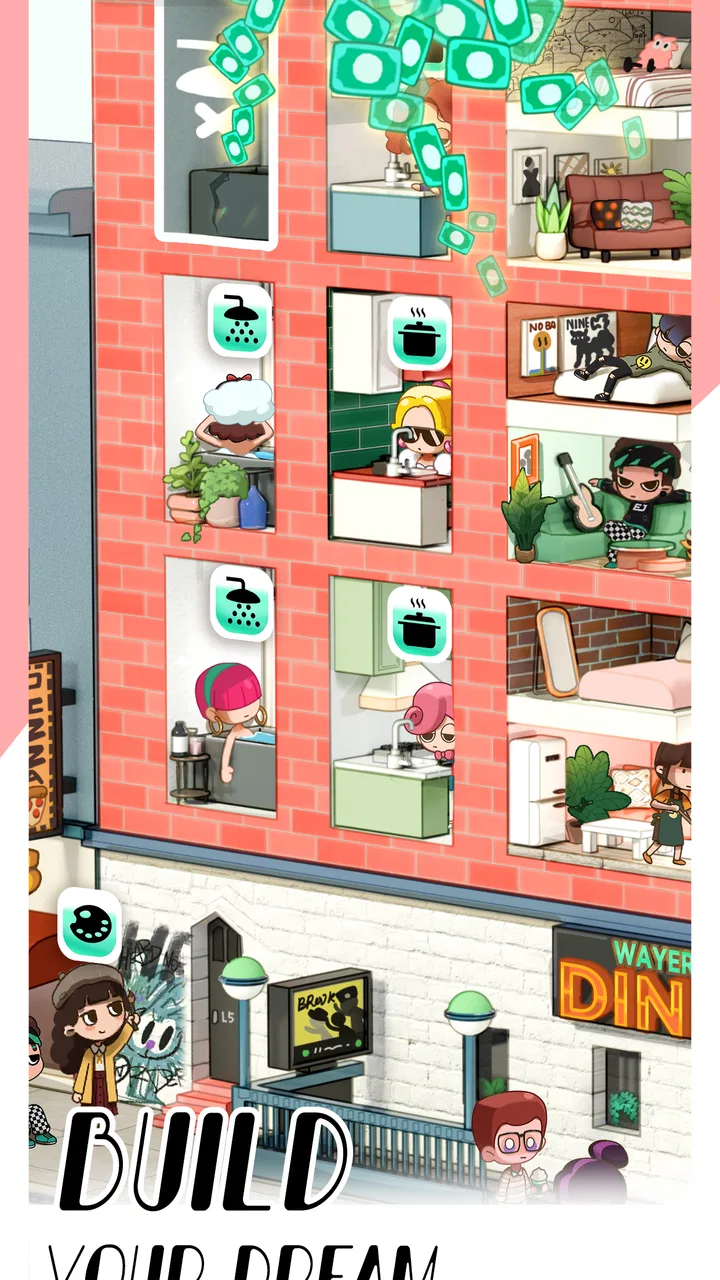
The opening experience works because the theme is immediately understandable. Instead of asking me to learn an abstract economy, it places the progress loop in a familiar setting: properties, tenants, improvements, and the feeling of turning a modest operation into something more successful. That context gives ordinary upgrades a purpose. I am not simply increasing a statistic; I am trying to make the rental business feel more capable.
I found the game easiest to enjoy when I focused on one practical objective at a time. Rather than tapping through every available action as soon as it appeared, I looked at which improvement would make the next return visit more useful. This is a small but important habit. Idle games can become noisy when every notification or available button feels equally urgent, while a simple priority keeps the session focused.
New players should not worry about making a perfect first run. The early stage is better used to understand the game’s pacing and identify which actions provide the most satisfying progress. I would avoid spending just because a purchase appears convenient during the first few sessions. Give yourself time to see whether the normal loop is enjoyable. If the basic cycle already feels rewarding, the game has a good chance of fitting your routine; if it feels repetitive immediately, payment will not solve that problem.
Where it is more convincing than typical alternatives
Its biggest advantage is the combination of a recognizable theme and low commitment. Compared with a more technical tycoon game, this is easier to pick up without studying a manual or remembering a complex chain of rules. Compared with a purely abstract idle game, the landlord setting gives the progress a little more personality. I always have a clearer mental picture of what the upgrades are meant to represent.
That makes it a good recommendation for someone who says, “I want a management game, but I do not want homework.” The simulation label is present, but the experience remains approachable. I can play in short bursts, leave it alone, and return without feeling that I have abandoned an intricate plan. That flexibility is valuable on a phone, where interruptions are normal rather than exceptional.
Another point in its favor is the sense of gradual ownership. The game frames improvement around a growing rental operation, which gives repeated actions a coherent direction. Even when the individual step is small, it contributes to the larger fantasy of becoming a more capable landlord. For me, that is more motivating than an idle loop with no setting beyond “make the number bigger.”
The game also benefits from being broadly approachable. Its Everyone content rating makes it suitable for a wide audience, including players who want a non-combat alternative to action games. That does not mean every adult simulation fan will find it deep enough, but it does make the premise easy to share with family members or friends who prefer calm, familiar subjects.
Its public reception suggests that many players connect with this format: the game holds a 4.4 average from around 378,000 ratings, with roughly 9,400 written reviews and over 10 million installs. Those figures do not guarantee that it will match your taste, but they do indicate that the combination of idle progression and rental management has reached a substantial audience.
Three habits that make the loop work better
My first practical tip is to separate “progress” from “activity.” A screen full of available actions can make me feel that I should perform all of them immediately, but that is not always the best use of a short session. I get more satisfaction by choosing the improvement that supports my next return, then stopping. This prevents the game from turning into a repetitive tapping chore.
Second, I would use the idle structure to fit the game around real life instead of arranging real life around it. A useful routine might be a quick check in the morning, another after work or school, and a final visit when I have time to make a more deliberate choice. The point is not the exact schedule; it is recognizing that the game is designed to coexist with other activities. If you keep reopening it every few minutes, the waiting element may become irritating.
Third, I would judge purchases by how they affect your patience, not by how attractive the immediate reward looks. A small optional purchase may feel harmless, but repeated convenience spending can change the way you view every delay afterward. I prefer to play long enough to identify whether the normal pace feels fair. If it does, spending remains a choice. If it does not, paying to remove friction may only make the underlying loop more visible.
A less obvious benefit of this approach is that it helps reveal what kind of player you are. If you enjoy planning the next return and watching a property operation develop, the idle structure is doing useful work. If you mainly enjoy rapid decisions and constant new challenges, the same structure may expose the game’s limits. That is a valuable test to make before investing time or money.
Where another type of game may suit you better
I would not choose this as my first recommendation for someone seeking a rigorous economic simulator. A deeper alternative in the same broad category may be better if you want detailed budgets, complex supply-and-demand relationships, or decisions where a single mistake can reshape the entire business. Rent Please! Landlord Sim is more welcoming, but that welcome comes partly from reducing the burden of precision.
I would also point action-oriented players toward a different category. There is no reason to expect the steady landlord loop to replace a city builder, a competitive strategy game, or a fast management title for someone who needs constant tension. The rental theme may sound like a business challenge, but the experience is better understood as a relaxed progression game with simulation flavor.
Players who dislike idle mechanics should think carefully before downloading. The central pleasure comes from returning to accumulated progress and deciding how to use it. If you prefer to earn everything through active play, waiting can feel like dead time rather than anticipation. In that case, a hands-on building or management game would probably offer a better match.
The same applies to people who want a completely predictable free experience. Optional purchases are part of the design, and the listed range extends from $0.99 to $99.99 per item. I would not call that automatically negative, because free entry is useful and some players are comfortable with optional spending. Still, anyone who wants to avoid purchase prompts altogether should choose a game with a different monetization approach.
What switching to it really costs
The financial cost of trying it is low because the game is free, but the more important cost is attention. Idle games can quietly occupy mental space: I may start thinking about the next upgrade, wondering whether I should check in again, or feeling that a short delay is blocking progress. For a player who enjoys that anticipation, it is part of the charm. For someone trying to reduce phone checking, it can work against the original goal.
There is also a learning cost, although it is modest. The landlord setting is easy to understand, but getting the most out of the loop still requires learning what to prioritize and when to stop. I would give it several normal sessions before forming a final opinion. One rushed session can make an idle game seem empty, while a longer trial reveals whether its rhythm fits your habits.
Device compatibility is fairly broad: the current version is 1.88.5.2 and it requires Android 7.0 or later. That makes it accessible to many Android users, though I would still check the requirements on the device you plan to use before committing to a long-term save. The game was released on October 24, 2022, so it is not a brand-new experiment; it has had time to establish its identity as a casual landlord simulation.
Switching from a deeper tycoon game may also require adjusting expectations. You might miss the freedom to redesign every part of a business or the satisfaction of solving a difficult economic puzzle. In return, you gain a lighter experience that is easier to pause and revisit. I see that as a trade rather than a flaw. The right choice depends on whether convenience or complexity is more important to you.
My recommendation for different kinds of players
I recommend giving it a try if you want a calm simulation game for short sessions, like the idea of improving rental properties, and enjoy progress that continues between visits. It is particularly suitable for casual players who want more theme than a bare idle counter but less pressure than a demanding management sandbox.
I would recommend it with reservations to players who are comfortable with free-to-play systems. Set a personal spending boundary before you begin, and do not assume every available acceleration is necessary. The game is most convincing when the ordinary landlord routine is enjoyable on its own. If you need to pay frequently to make the pace tolerable, that is a sign that this may not be the right fit.
I would skip it if your ideal simulation requires deep financial modeling, constant strategic tension, or complete freedom over every part of the operation. A more detailed tycoon or city-management game will likely reward you more. I would also skip it if idle progression itself feels frustrating, because the landlord theme cannot remove the waiting at the heart of the experience.
For me, the final decision is favorable but specific: Rent Please! Landlord Sim is best as a friendly, low-pressure property-management pastime, not as a substitute for a serious business simulator. ShimmerGames has chosen an inviting middle ground, and the game’s broad audience reflects how easy that middle ground is to understand. I would install it when I want a few satisfying check-ins and a visible sense of growth, while keeping my expectations realistic about depth and optional spending.
My clear recommendation: try it if you want an accessible idle landlord game and can enjoy gradual progress without forcing every reward to arrive immediately. Play patiently, prioritize one improvement at a time, and decide about purchases only after the basic loop has earned your trust. In that role, it works well; outside it, a more active or more detailed simulation will be the better choice.
FAQs for Rent Please! Landlord Sim
01What is the main objective of Rent Please! Landlord Sim?
Rent Please! Landlord Sim is a simulation game where players take on the role of a landlord. The main objective is to manage and expand your property empire by acquiring new properties, setting rent prices, and ensuring tenant satisfaction. The game challenges players to balance financial growth with maintaining a positive living environment for tenants.
02Is Rent Please! Landlord Sim free to play?
Yes, Rent Please! Landlord Sim is free to download and play on both Android and iOS platforms. However, the game includes in-app purchases that offer additional features and resources. Players can choose to spend money to speed up their progress or enhance their gaming experience, but it is not necessary to enjoy the game.
03What are the key features of Rent Please! Landlord Sim?
Key features of Rent Please! Landlord Sim include property management, tenant interactions, and financial strategy. Players can purchase and upgrade properties, set competitive rental prices, and deal with tenant requests and complaints. The game also includes various challenges and events to keep the gameplay engaging and dynamic.
04Can I play Rent Please! Landlord Sim offline?
No, Rent Please! Landlord Sim requires an internet connection to play. The game regularly updates with new events, challenges, and features that require online access. Additionally, some elements of the gameplay, such as leaderboards and social interactions, depend on being connected to the internet.
05How does Rent Please! Landlord Sim ensure a fair play environment?
The developers of Rent Please! Landlord Sim have implemented a series of measures to promote fair play. This includes regular updates to address bugs and balance gameplay, as well as systems to prevent cheating and exploitation. Players are encouraged to report any issues to ensure a fair and enjoyable experience for everyone.
Pros
- Engaging gameplay with realistic landlord tasks.
- User-friendly interface ensures easy navigation.
- Variety of properties keeps the game interesting.
- Regular updates with new features and challenges.
- Offline mode available for on-the-go play.
Cons
- In-app purchases can get expensive.
- Some tasks may feel repetitive over time.
- Limited customization options for properties.
- Occasional bugs may disrupt gameplay.
- Ads can be intrusive and frequent.

Rent Please! Landlord Sim
Gallery